
Excited, a little bit apprehensive, and above all — very hopeful.
This is how we’re feeling at the Alliance to End Homelessness Ottawa, in the aftermath of the release of the 2026 federal budget.
With a headline goal of “putting Canada on a path to end homelessness within 10 years,” we see in this budget a kind of political courage that actually sets the foundation for getting there.
After previous National Housing Strategy goals failed to materialize, there’s understandable skepticism about any government commitment on homelessness. The proof, absolutely, will be in the outcomes, and there’s still room for greater courage and deeper commitment by our elected leaders, especially when it comes to addressing Indigenous homelessness and housing insecurity.
But after years of seeing insufficient prioritization of non-market housing and more focus on band-aid solutions to a growing emergency, Budget 2026 gives us real signs that this government is moving in the right direction.
In it, the feds clearly recognize that solving our housing crisis must start by meaningfully addressing homelessness (an area where we know the current National Housing Strategy has fallen woefully short). Even more importantly, Budget 2026 puts significant investment behind evidence-backed solutions.
Here at the Alliance, we’re eager to see how specific implementation details will be worked out — we’ll continue engaging with the office of the federal Housing Minister on this, and we want to hear from you about specific questions and priorities (more on the opportunities to do so, at the end of this document).
We’ll also be urging the province to step up with equal or greater ambition in response to the new federal commitments, as we know their buy-in will be critical to making non-market housing and supportive services operationally feasible.
And critically, at the municipal level, we’ll be working to capitalize on the window of opportunity that Budget 2026 creates for our community. Last week, the prime minister stated that his government is ready to work with all willing partners in the push to end homelessness — a vision shared at Ottawa’s City hall under our re-elected mayor, at the Housing and Homelessness Leadership Table where City and sector leaders convene, among funders and champions in the community, and here at the Alliance in all the work that we do.
We’re a ready and committed ally. And we want decision-makers to know that Ottawa has a high-capacity system that will coordinate and transform to achieve the outcomes that multiple levels of government are now actively pursuing. We look forward to reporting back on any additional news for our sector, but for now, we wanted to share what we’re taking away from Budget 2026, and more on what it could mean for our member organizations.
Creating the conditions to end homelessness: Maintaining essential supports and leaning into supportive housing
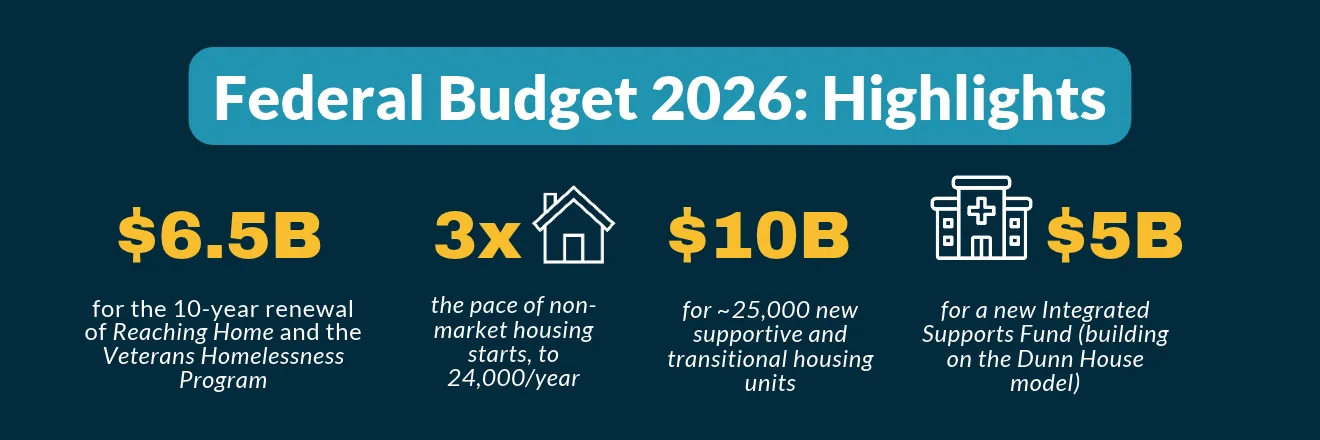
Our very first takeaway during the federal budget lockup — Kaite, the Alliance’s executive director, attended in-person — was extreme relief to see the commitment to renew Reaching Home and the Veterans Homelessness Program for 10 more years, under the broader pledge to position the country to end homelessness in the same time frame.
As Reaching Home is retooled for the coming decade, we hope to see a strong emphasis on prevention, quick access to permanent housing and supports, and using real-time data to drive real reductions in homelessness. So we are eager to get into the additional details that the Budget promises are coming “early in the new year.”
Our collective sigh of relief also extends to the news that the Canada Housing Benefit for low-income renters is being renewed for 10 years. There has been significant anxiety in the housing and homelessness sector that these benefits would be cut off. As of now, it does appear that this will only support existing recipients. Housing benefits are a critical tool to help prevent people from becoming homeless and quickly provide a permanent housing option for people who do become homeless. Their impact on helping move people out of the emergency shelter system cannot be understated. Moving forward, this will be a key point of advocacy from the Alliance.
We welcome the creation of a new “Integrated Supports Fund” under the Build Canada Homes federal agency, which would “support projects that bring housing together with health, mental health, addictions, and social supports.” According to the Budget, this new fund will support developing new transitional and supportive housing, adapting existing buildings, and mobilizing “public, private, and philanthropic capital behind an integrated housing and care model.”
Separately, the Budget plans to additionally invest $10B to build approximately 25,000 new supportive and transitional housing units, making it clear that the provinces/territories will be expected to fund “ongoing operations and wraparound services.”
It’s one of the ways that this budget sees the federal government lead with housing and homelessness commitments of their own, while delineating how other levels of government will be expected to contribute. This will be something to monitor leading up to the 2027 federal economic update in the spring, ahead of which the Budget states the federal government and the provinces/territories will work on their bilateral agreements to align them with goals that include ending homelessness in a decade and “protect(ing) existing non-market housing stock.” We are very interested to see what opportunities for provincial action this encourages.
Another $2B over two years, starting in 2027, will go into the “Health Infrastructure Fund” to build and repair community mental health and addictions facilities. We were heartened to see the explicit focus on early intervention with this investment, with the Budget stating that “facilities funded will provide care before people reach a crisis point.”
We also see the Budget celebrating and rewarding jurisdictions where other levels of government are willing to invest in holistic supportive housing models — and reap the benefits.
Highlighting Toronto’s existing Dunn House supportive housing development — and the 79% reduction in hospital stay length/$2.1 million in savings it realized within the first two years of operation — the Budget announced a new $1B+ capital investment in Winnipeg. This initiative will include new permanent supportive and transitional housing, a new centre for mental health and addictions, and the province stepping up to fund “the ongoing services needed to make these investments successful.”
While we remain concerned about continued investment in transitional beds at the expense of additional permanent housing — stop-gap solutions are rarely preferable to stability and a key to your own home — it is positive to see such explicit focus in this budget on ending homelessness as a goal, anchoring the discussion as the federal government moves to update the National Housing Strategy in 2027.
Expanding non-market housing, room for more support on urban Indigenous housing and homelessness
Another question mark we had going into this budget was the extent to which non-market housing would be part of this government’s agenda. With a federal housing assessment tool finding that 84% of the affordable housing deficit in Ottawa alone (people in core housing need) was for low and very-low income households, we were thrilled to see non-market housing expansion as a pillar of the 2026 Budget.
With a $13B investment aiming to triple the pace of non-market housing starts across Canada in the next decade, there was a message beneath the numbers that echoes what non-profit, supportive, and co-op housing providers have long said: “Over the past several decades, the growth of Canada’s non-market housing supply has simply not kept pace with Canadians’ housing needs.”
We were also glad to see the Budget acknowledge that non-market housing needs to be a core, permanent fixture of our development pipeline, stating that “the goal is not simply to fund more projects, but to build a permanent housing delivery system capable of producing affordable homes at scale.”
The Budget additionally states that at least 10% of the expanded envelope for Build Canada Homes will be dedicated to Indigenous housing projects using a distinctions-based formula. However, we echo the concerns of the Canadian Housing and Renewal Association (CHRA) that the federal budget makes no specific mention of urban, rural, and northern Indigenous housing — a major missing piece, considering the overwhelming majority of Indigenous people in Canada live in such areas (approximately 50,0000 in Ottawa), and the disproportionate impact of homelessness on Indigenous people.
We will continue to support our colleagues at the Ottawa Aboriginal Coalition as they work to develop housing and supports for First Nations, Métis and Inuit community members in Ottawa, including through a locally driven Indigenous Housing and Homelessness Strategy and a goal of establishing 1,000 new homes for Indigenous people by 2034.
Finally, and with particular relevance for our city, federal lands also see dedicated mention under the “expanding non-market” pillar of this budget — in line with our position that using public land for non-profit housing is its highest and best use. The Budget says an additional investment of $1.5B over four years will support infrastructure these lands need to become housing-ready, lowering the cost of affordable development.
We want to hear from you: Budget 2026 questions and priorities
Our initial budget analysis — and opportunity for continued impact in conversations with decision-makers — will be strengthened by the feedback we get from Alliance members in the coming days and weeks.
With that in mind, we’ve created a Google form. We want to know: was this analysis helpful to you? What questions about the 2026 federal budget do you still have? And where would you like to see federal housing- and homelessness-related advocacy focus in the coming weeks and months? (In addition to debate over the Budget in Parliament, discussion will continue on the new National Housing Strategy and Reaching Home).
Thank you for being part of this movement. We truly believe last week’s budget would not have come forward without the collective work of advocates, sector leaders, and frontline workers, making sure our elected officials understand the urgency of this crisis and the solutions we need to see.